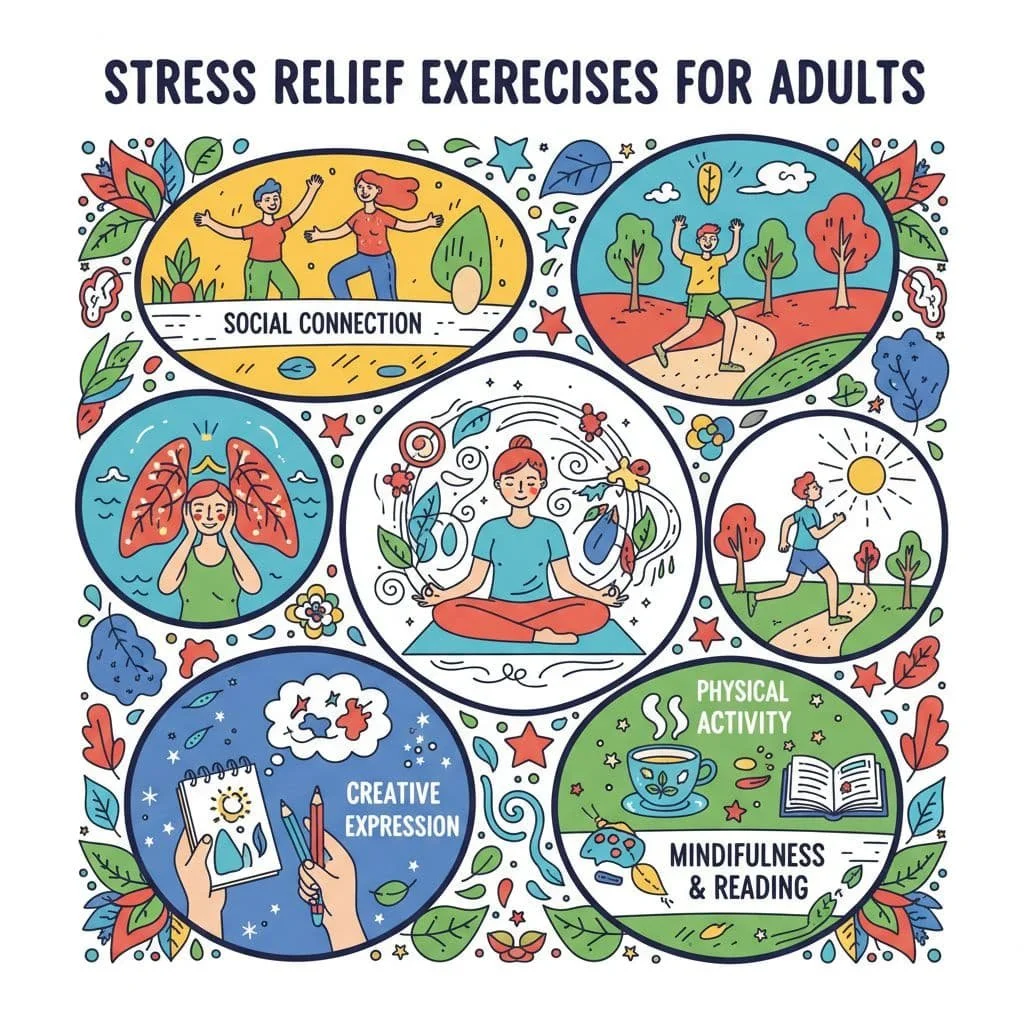
Simple Ways to Feel Better Fast
Stress can feel like a browser with 37 tabs open, and one of them is playing music you can’t find. Stress relief exercises for adults can greatly help in managing these feelings. You might be doing “fine” on the outside, but your shoulders creep up, your jaw stays tight, and your thoughts run in circles.
The good news is that stress relief exercises for adults don’t have to be long, expensive, or perfect. The right exercise, done at the right moment, can calm your nervous system and give you a sense of control again.
Start here: your body needs a “safe” signal
When stress comes along, your body responds as if there’s a threat, only in this case the “threat” is an inbox, traffic, or family demands. Your heart rate goes up, breathing becomes shallow, muscles tighten, and your focus narrows.
The aim of stress relief exercises is straightforward: Send your body the message that you are safe. Once your body is convinced of that, the mind tends to follow.
Breathing exercises that work when you’re busy
Deep breathing outdoors in a quiet park setting,
You don’t need any special equipment at all to soothe your system. You need a few slow breaths that change your physiology.
If you have time to try just one thing from this post, make it this one: extend your exhale longer than your inhale. Longer exhales also seem to reduce the “negative effect of an already overly negative ”state”—that is, reducing past baggage.
Box breathing (steady and simple)
Box breathing is structured, which can be comforting when you feel scattered.
How to do it:
- Inhale through your nose for 4 seconds.
- Hold for 4 seconds.
- Exhale for 4 seconds.
- Hold for 4 seconds.
Repeat for 4 to 8 rounds.
If 4 seconds feels like too much, do 3 seconds. The point is control, not struggle.
4 to 6 breaths (great for anxiety spirals)
This is even easier and often feels more natural.
Breathe in through your nose for 4 seconds, then out through your mouth for 6 seconds. Repeat for 2 to 5 minutes. And if your mind wanders, it probably will. Just come back to counting.
For stress reduction strategies that are more based on medicine, Harvard Health details methods such as breathing and relaxation in Six relaxation techniques to reduce stress.
Release stress you’re holding in your muscles
Some stress doesn’t feel emotional at all. It feels physical. A stiff neck. A heavy chest. Low-grade tension you only notice once it’s gone.
Progressive muscle relaxation (PMR) for a tight body
PMR teaches your body the difference between “tense” and “relaxed.” Many adults walk around slightly clenched all day without realizing it.
Try this quick version (about 5 minutes):
Tense each area for 5 seconds, then relax for 20 to 30 seconds.
Go in this order: feet, calves, thighs, glutes, stomach, hands, arms, shoulders, jaw, forehead.
If you clench your jaw when you’re stressed, spend extra time there. Relax your tongue too. It makes a difference.
A 3-minute stretch reset (desk-friendly)
Stretching won’t erase stress, but it can interrupt it. It’s like hitting “refresh” on your body.
Do this once mid-morning and once mid-afternoon:
- Shoulder rolls: 10 slow circles back, then 10 forward
- Neck tilt, ear toward shoulder, 3 breaths per side
- Chest opener, hands behind back (or hold a towel), 5 slow breaths
- Forward fold (standing or seated), let your head hang, 5 slow breaths
If you want more ideas that fit real life, 7 Quick Stretches for Stress Relief You Can Do Right Now offers clear, practical options.
Movement as stress medicine (even when motivation is low)
When you’re stressed, high-intensity workouts are probably the last thing on your mind. That’s okay. The best movement is the one you will do.
Imagine stress as surplus energy your body stored away to use in case of emergency. Motion provides that energy a place to push off.
The “10-minute rule” (surprisingly powerful)
Promise yourself 10 minutes of movement. If you want to stop after 10, stop. Most days you’ll keep going, but you don’t have to. This rule lowers the mental barrier.
Good 10-minute options:
- A brisk walk outside
- Walking stairs in your building
- A short bike ride
- A living room dance break
- A gentle yoga flow
Even short workouts can help. The New York Times described a compact routine built for busy days in 10 Quick Stress-Relieving Exercises for a 7-Minute Mental….
A simple strength routine that calms your mind
The grounding nature of strength training comes from the way it draws you into the present. You must count reps, monitor form, and breathe.
If you’re looking for a beginner gym workout (or even just generally want to better understand how to use the equipment at your gym), give this two-day plan a try for stress relief (and some basic strength). Keep the weights light enough so you could do 2 more reps at the end of each set.
Day A (about 35 minutes):
- Leg press or goblet squat: 3 sets of 8 to 10
- Seated row: 3 sets of 8 to 10
- Dumbbell bench press or push-ups: 3 sets of 8 to 10
- Farmer carry (hold weights and walk): 3 rounds of 30 to 45 seconds
Day B (about 35 minutes):
- Romanian deadlift (dumbbells) or hip hinge machine: 3 sets of 8 to 10
- Lat pulldown: 3 sets of 8 to 10
- Step-ups: 3 sets of 8 per side
- Plank: 3 rounds of 20 to 40 seconds
Keep rest periods slow and steady. Inhale through your nose, exhale fully. That breathing style turns lifting into one of the most practical stress relief exercises for adults.
For a broader look at how movement and mindfulness work together, Harvard Health also explains the connection in How to reduce stress and anxiety through movement and mindfulness.
Mindfulness exercises for when your thoughts won’t quit
Some days, your body isn’t where the stress is to start with. It’s in your mind. Worry loops. Worst-case stories. A perpetual feeling of being behind.
Mindfulness is not about “clearing your mind.” It’s about acknowledging what’s happening and not contributing further fuel to the fire.
The 5-4-3-2-1 grounding exercise (fast and discreet)
This works well in meetings, at the grocery store, or before a tough phone call.
Name:
- 5 things you can see
- 4 things you can feel
- 3 things you can hear
- 2 things you can smell
- 1 thing you can taste (or one thing you appreciate right now)
It pulls attention out of “what if” and back into “what is.”
Body scan (a bedtime reset)
Lie down, close your eyes, and slowly move attention from toes to head.
You’re not fixing anything. You’re checking in. For many adults, that alone softens the stress response.
Fun stress relief activities for adults (because joy is part of health)
If you’ve been holding onto a plan for dealing with stress that consists of little besides “work harder at relaxing,” it’s going to backfire. Fun is important because it shifts your state fast and gently reminds your brain that there’s more to life than problems.
Fun Stress Relief Activities for Adults These stress relief activities are all just plain fun and do not take much time:
Music as medicine: Throw on a song and dance like no one’s watching. Even two minutes can change your mood.
A “small win” hobby: puzzles, doodling, cooking, or gardening. Select something that has a defined ending.
Intentional laughter: Watch a brief comedy video or exchange memes with a friend. It’s not silly; it’s regulation.
Get outdoors: shoot hoops, toss a Frisbee around, and walk to someplace new. Novelty helps your brain reset.
Hands-on calm: Working dough, folding laundry, building a LEGO set with your kid. Repetitive motion can be soothing.
These are stress management techniques for adults too, because the nervous system responds to pleasure and connection. You’re not “wasting time.” You’re recovering.
Put it together: a realistic daily stress plan
Most people don’t need more information. They need a plan that fits a normal weekday.
Use this as a starting point and adjust it to your life:
| Time of day | What to do | Why it helps |
| Morning (2-3 minutes) | 4 to 6 breaths | Starts your day with a calmer baseline |
| Midday (10 minutes) | Walk outside or take a light bike ride | Burns off stress energy and improves focus |
| Mid-afternoon (3 minutes) | Desk stretch reset | Releases tension before it stacks up |
| Evening (5 minutes) | PMR or body scan | Helps your body shift toward rest |
| Anytime (60 seconds) | 5-4-3-2-1 grounding | Stops spirals and brings you back to now |
If you want extra ideas beyond exercise, Verywell Mind has a broader list of options in 18 Effective Stress Relief Strategies.
When stress starts to feel like too much
Self-help tools matter, but they’re not a substitute for care when things get heavy.
Consider talking with a clinician if stress:
- wrecks your sleep most nights
- causes panic symptoms
- pushes you toward alcohol or substances to cope
- makes you feel numb, hopeless, or unsafe
Support can include therapy, skills-based approaches, and in some cases medication. Getting help is a strong move, not a weak one.
Conclusion
You don’t get to ditch stress just because you read a good tip. It begins to lessen when you engage in little things to say to your body, “I’m safe right now.” Breath, muscle release, movement, mindfulness—and even play—all do that in their own ways.
Choose one workout you will do from today, not five that you’ll “start Monday. Your nervous system learns by repetition, and baby steps add up quicker than you might imagine.
Key Takeaways
- Stress relief exercises for adults are essential for managing physical and mental tension quickly.
- Breathing techniques, like box breathing and the 4 to 6 breaths method, can help alleviate anxiety and stress.
- Progressive muscle relaxation (PMR) and simple stretching can release physical stress stored in muscles.
- Incorporating fun stress relief activities, such as dancing or outdoor play, is crucial for overall health.
- A realistic daily stress plan can help individuals maintain calmness and manage stress effectively throughout the day.
Estimated reading time: 8 minutes


The app version is so convenient for playing on the go. It is stable and doesn’t crash like other apps I have used. Check out uujiliapp
I have been using this platform for a while now and the payouts are consistently fast. Definitely one of the most reliable sites I have encountered. Check out idrpvip5 if you want a premium feel.
Such a friendly community and the rewards are actually generous. Loving my time on jililoveapp
I’ve tried many platforms but this one is really smooth. The payouts are fast and the games are super exciting. Definitely a great choice for locals! phpjiliph
The login process is seamless and the site loads incredibly fast. Great job to the jilimklogin team.