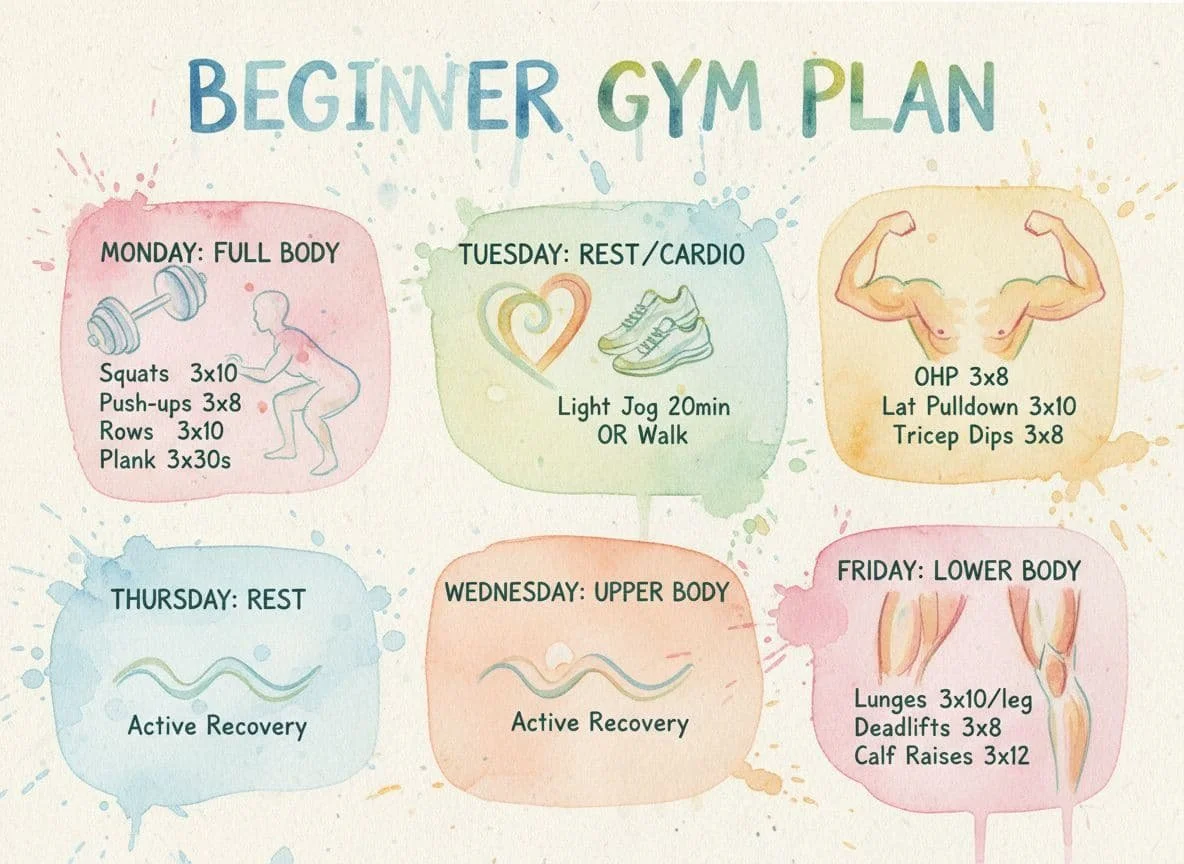
A Simple 4-Week Routine You’ll Actually Stick With
Getting started with a gym workout plan for beginners can be easier compared to dealing with crowded hallways or packed locker rooms at your local gym, but it still might feel like the first day of school, won’t it? Everybody looks like they do, machines seem difficult to understand, and it’s simple to worry you’re going to mess something up.”
The truth is this: beginners don’t need more intensity (going harder or longer); they need a plan that gives them a clear, repeatable process and grace on busy weeks. This guide will help you through a realistic first month at the gym but also teach you the basics of recovery and eating so your great effort results in something tangible that you can feel.
What to do before your first week at the gym
The best gym workout plan for beginners starts before you even grab a dumbbell. But not because you need to “prep” weeks in advance—but just to prepare a bit and stop some of the most common problems in that important first week (fatigue, random workouts, or working out too hard/at too high an intensity).
Choose one final goal for 4 weeks. Examples: establish routine, get stronger, drop 5 pounds, boost energy. There’s potential for more than one benefit, but you will train better if you’re not trying to chase everything at the same time.
Make the first month intentionally simple. Your role is to learn, practice hitting your limits, and show up.
If you want a quick look at what a commercial gym considers a realistic first week, this Planet Fitness guide is a helpful reference: A beginner workout plan for your first week in the gym.
The beginner plan you’ll follow (and why it works)
Generally speaking, 3 strength days per week (with 1 to 2 optional low-stress days: walking, easy cardio, mobility) is magic for most people ages 25-50. That gives your muscles a reason to adapt, all while allowing recovery time to account for work, sleep, and life.
You cycle them on and off for three days a week.
Weekly schedule (repeat for 4 weeks)
| Day | Plan | Time |
| Monday | Strength Workout A | 45 to 60 minutes |
| Tuesday | Optional: easy cardio or walking | 20 to 35 minutes |
| Wednesday | Strength Workout B | 45 to 60 minutes |
| Thursday | Optional: mobility or easy cardio | 15 to 30 minutes |
| Friday | Strength Workout A (next week starts with B) | 45 to 60 minutes |
| Saturday | Optional: long walk, bike, or rest | 20 to 60 minutes |
| Sunday | Rest | No gym needed |
If fat loss is one of your goals, you might like this realistic, beginner-friendly framework from Anytime Fitness: A realistic 4-week weight-loss workout plan for beginners.
Warm-up and cool-down (the part beginners skip, then regret)
Warm-ups don’t require a lot of time; they require focus. The idea is to warm you up, loosen your joints, and “wake up” the muscles you are about to use.
5- to 8-minute warm-up (do this every strength day):
- Brisk treadmill walk or easy bike: 3 minutes
- Leg swings (front to back) and arm circles: 30 seconds each
- Bodyweight squats: 8 slow reps
- Incline push-ups on a bench: 8 reps
- Light set of your first exercise: 10 reps
3- to 5-minute cool-down:
- Walk until breathing feels normal
- Stretch the muscles you trained (gently, not painfully).
This routine keeps you safer and also helps you lift better and faster.
Strength Workout A (full body, beginner-friendly)
After warming up, do the exercises in order. Choose a weight that lets you finish the set with about 2 reps left in the tank. You should work, but you shouldn’t grind.
Workout A
- Leg press: 3 sets of 8 to 12 reps, rest 90 seconds
- Dumbbell bench press (or chest press machine): 3 sets of 8 to 12 reps, rest 90 seconds
- Lat pulldown: 3 sets of 8 to 12 reps, rest 90 seconds
- Romanian deadlift with dumbbells (hinge): 2 sets of 8 to 10 reps, rest 90 seconds
- Plank: 2 sets of 20 to 40 seconds, rest 60 seconds
Form a cue that pays off quickly: Pretend you are trying to be quiet. Controlled reps keep your joints safe while building real strength.
If you’re looking for a little more of an overview of the basics of strength training and what sorts of exercises would fall into this category, here’s a good rundown from Gold’s Gym in general: Gym workouts for beginners, strength training.
Strength Workout B (full body, with different angles)
Workout B
- Goblet squat (dumbbell held at chest) or hack squat machine: 3 sets of 8 to 12 reps, rest 90 seconds
- Seated cable row: 3 sets of 8 to 12 reps, rest 90 seconds
- Dumbbell shoulder press (or shoulder press machine): 2 to 3 sets of 8 to 12 reps, rest 90 seconds
- Hip thrust machine or glute bridge: 2 sets of 10 to 12 reps, rest 90 seconds
- Pallof press (cable anti-rotation) or dead bug: 2 sets of 8 to 10 reps per side, rest 60 seconds
If an exercise bothers your joints, swap it. Pain is not a “push through it” signal. It’s data.
What a “good” weight feels like (so you don’t guess)
Beginners often go too light and never challenge the muscle, or too heavy and turn every rep into a wobble.
Use this simple test:
- If you could do 5 more reps, it’s too light.
- If your form breaks before the target reps, it’s too heavy.
- If the last 2 reps are slow but clean, you’re right on target.
Write down your weights in a notes app. Small improvements add up fast when you can see them.
Optional cardio that won’t wreck your recovery
You don’t need brutal cardio to get in shape. In your first month, cardio should support your strength training, not compete with it.
Good options on non-lifting days:
- Incline treadmill walk
- Easy cycling
- Rowing at conversational pace
- Short elliptical session
A simple rule: you should be able to talk in short sentences while doing it. If you’re gasping, it’s not “wrong”; it’s just not what you need most right now.
A quick visual of the vibe (you belong here)

You don’t have to look like a fitness influencer to train with confidence. You just need a plan you can repeat.
Progression for weeks 2 to 4 (how to get results without overthinking)
The easiest progression system for a gym workout plan for beginners is called “double progression.”
Here’s how it works:
- Pick a rep range, like 8 to 12.
- Use the same weight until you can hit 12 reps on all sets with clean form.
- Then increase the weight slightly next time (often 5 pounds total for lower body, 2.5 to 5 pounds for upper body).
- Your reps will drop back toward 8, and then you build up again.
This keeps you moving forward without guessing.
Common beginner mistakes that slow progress
Doing too much in week 1. Soreness isn’t the goal. Consistency is.
Skipping rest days. Muscles recover in repose, not perspiration.
Changing the plan daily. Variety is enjoyable, but gains only arrive from hammering the basics for long enough to get better.
Training abs every day. Your core gets trained in your squats, hinges, rows, and carries. Add some core work, but don’t overthink it.
If you’re looking for more of a month-or-so-long ramp-up to agility, Muscle & Fitness also has an in-depth plan that you can compare and contrast with: 4-week beginner workout plan for strength and fat loss.
The “total gym diet plan” approach (simple nutrition that matches your workouts)
Everyone wants a Total Gym diet plan as though it were a rigid menu. A healthier way—applicable most anywhere, by the way, at home, at work, and on weekends (not including those gym days)—is a modest construct that you can follow:
Focus on three anchors:
Protein at most meals. It aids recovery and keeps you full. Low-hanging fruit: Chicken, Greek yogurt, eggs, tofu, beans, and protein shakes if you need them.
Plants daily. Fruit and veggies are good for digestion, energy levels, and general health.
Carbs around training. Carbs are not the enemy. They can also make workouts feel less jerky. Rice, oats, potatoes, fruit, tortillas, and whole-grain bread all fit the bill.
A practical starting point:
- 3 meals per day
- 25 to 40 grams of protein per meal (adjust based on your body size and appetite)
- 1 to 2 snacks if your day is long
For more beginner-friendly nutrition guidance, these are solid reads:
- Diet for gym beginners: fuel your workouts the right way
- Ultimate beginner diet plan for smarter eating and fat loss
One habit that works: pack a “default lunch” you like (protein, carbs, produce). Decision fatigue is real, especially on stressful workdays.
Gym workout plan for beginners female: what changes (and what doesn’t)
A gym workout plan for beginners Female is not a totally different plan. Women get the same fundamental basics: progressive strength training, adequate protein, and smart recovery.
What can vary is how you use it.
A few helpful tweaks:
- If you’re new to bracing and breathing, start lighter on squats and hinges. Learn to keep your ribs down and core tight.
- If pelvic floor symptoms show up (leaking, heaviness, pain), scale the intensity and consider working with a qualified pelvic health pro.
- If your cycle affects energy, adjust the optional cardio days first. Keep strength days; just reduce weight by 5 to 10 percent when needed.
If you want a women-focused walkthrough with exercise examples and FAQs, this can help you feel more grounded: Female beginner gym workout plan.
Ladies’ gym workout plan for beginners: confidence tips that matter on real-life days
A ladies’ gym workout plan for beginners often fails for one reason: it feels mentally exhausting. The plan above is simple, but these small choices make it easier to follow when you’re tired.
Pick “low-friction” defaults:
- Go at the same time of day when possible.
- Wear the same go-to gym outfit so you don’t negotiate with yourself.
- Start every lift with the same warm-up flow.
Use the 10-minute rule. On rough days, promise yourself 10 minutes. If you still want to leave after that, leave. Most days, you’ll stay.
Don’t wait to feel confident. Confidence is usually the result of showing up, not the requirement.
How to know you’re making progress (without obsessing)
Scale weight is one data point, not a verdict.
Track 2 to 3 of these for the next month:
- You add reps or weight on key lifts
- Your resting heart rate trends down
- You feel less winded on stairs
- Your clothes fit better
- You sleep more soundly
If you only hit the gym twice in a week, don’t scrap the whole thing. Just return to the next scheduled workout. Consistency beats perfection every time.
Conclusion
A good beginner’s gym workout plan is straightforward enough to learn so that you can get out of the gym as well. Three days a week of full-body training, make the cardio easy, and go up in weight only when your form is clean. Combine it with eating like you’re on Total Gym (real protein, plants, and carbs), and I guarantee you’ll feel the effects sooner than later.
Begin your initial workout this week, and let momentum carry you from there. The perfect is the enemy of the good: the best program is the one you can follow effectively to get stronger.
Key Takeaways
- A gym workout plan for beginners should focus on three strength training days per week, interspersed with optional low-stress cardio days.
- Establish a simple goal for four weeks, emphasizing consistency and gradual progress without overwhelming intensity.
- Begin each workout with a warm-up and finish with a cool-down to prevent injuries and enhance performance.
- Follow two strength workouts (A and B) with specified exercises, reps, and rest times for balanced development.
- Track progress through added reps or weight and notice improvements in daily activities, not just scale weight.
Estimated reading time: 10 minutes


Such a fun and colorful site! The graphics are great and the gameplay is very addictive in a good way. Definitely visit panda1001slot for some excitement.
The welcome package here completely changed how I approach my weekly budget. I loved how the wagering requirements stayed completely transparent from day one. Every deposit matched perfectly and the free spins rolled out right on schedule. Grab the offer before it disappears for good. bdcbajivp
The variety of games available here is impressive. I spent the whole weekend exploring different tables and everything works perfectly. Highly recommended for PH players. Explore phjili98