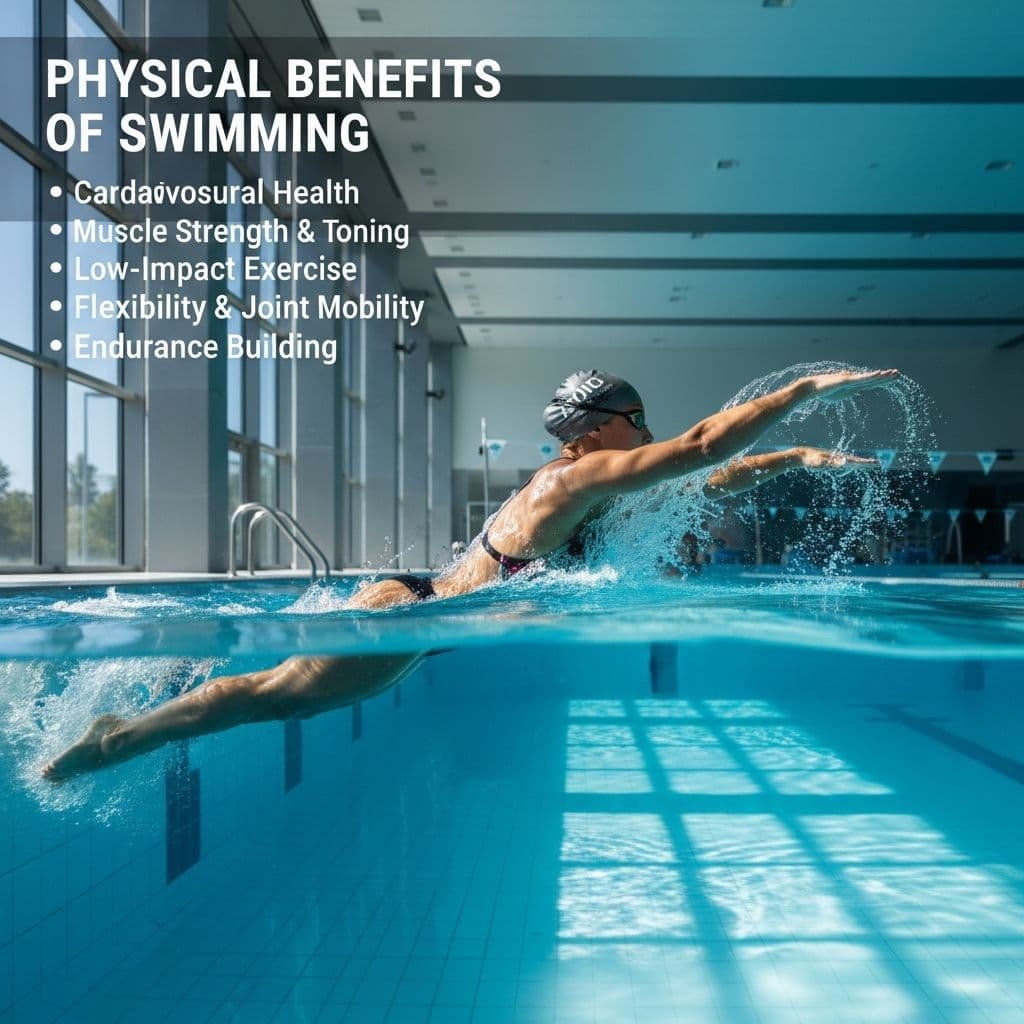
(Why Your Body Loves the Water)
When your workouts already seem like a battle against your knees, back, or schedule, swimming feels like a cheat code. You work hard, but the water supports you. It’s soothing and demanding both at once, like a walk uphill on a moving sidewalk.
A good cardio, the physical benefits of swimming are far more significant anyway. Swimming is able to increase endurance of your heart and lungs, build full-body muscle strength, improve flexibility of joints, and support weight loss goals while remaining low-impact. And because water adds resistance in every plane of motion, you’re working harder than it appears, even when going at a steady pace.
A full-body workout that doesn’t feel like one
Most gym workouts stick to their lane: legs, arms, core, and cardio. Swimming blends them. Even if you’re on an “easy” freestyle swim, your shoulders are set, you stabilize with the core as you progress through the water, your hips rotate, and your legs kick to keep moving.
Water also changes the rules. It’s denser than air, so you encounter resistance with every pull and kick. Which is to say, swimming trains strength and endurance simultaneously, particularly in the upper body and trunk—anatomical regions many people under-train on land.
What it can improve over time:
- Muscle balance (left to right and front to back), because strokes demand symmetry
- Posture strength, since your upper back and core work constantly to keep alignment
- Work capacity, because continuous laps build stamina without pounding joints
If you’re coming from running or lifting, the first surprise is often the “whole-body tired.” Swimming spreads the effort across your system, not just one muscle group.
Heart and lung health that adds up fast

Swimming is cardio training, and swim practice is also breathing practice. You learn to control your breathing, breathe out fully underwater, and take rapid, economical breaths. And over time, that one-two punch helps you develop stronger cardio fitness and use oxygen more efficiently.
The research has shown that swimming through 2025 is associated with greater cardiovascular endurance, lower blood pressure, and improved overall heart health. One recent report in Scientific Reports examined various forms of water training and found that interval-based swimming led to increased cardiovascular endurance, strength gains resulted from aquatic resistance work, and both modes were effective for improving mobility. (Scientific Reports study).
On a practical level, here’s what swimmers often notice first:
- Stairs feel easier.
- Resting heart rate may trend down with consistent training.
- You recover faster between hard efforts (in workouts and daily life).
Harvard Health also summarizes why water workouts can be so effective for cardiovascular fitness while staying gentle on the body (Harvard: water workouts).
Stronger muscles with less joint strain
Weight lifting is similar to moving metal through space. Swimming, meanwhile, is akin to moving your body through a dense but supportive gel. Water resistance makes your muscles work without the same compressive force on your joints that you get from jumping, sprinting, or heavy land-based exercises.
That’s why swimming often works well for people managing:
- nagging knee pain
- hip stiffness
- plantar fasciitis flare-ups
- post-injury return to exercise
- arthritis symptoms
You’re horizontal and buoyant, so your joints aren’t subjected to repetitive impact. At the same time, muscles continue to work hard, particularly those in the shoulders, lats, and deep core.
Someone I was swimming with told me that when you are in the ocean, feeling scared is like trying to hold someone under water. It is against you, but it is for you.
For a more general look at the advantages of water-based exercise, such as how buoyancy lessens joint load, Harvard’s explainer is a good place to begin (Advantages of water-based exercise).
Better mobility and flexibility (without a stretching session)
Swimming isn’t a substitute for all mobility work, but it does promote joint movement in ways that many daily activities do not. Your shoulders go through big ranges. Your spine rotates. Your ankles point and flex. Your hips are straightening and rotating with each stroke.
Over time, many swimmers report:
- looser hips
- better shoulder control (when technique is sound)
- less stiffness after long workdays
But the gains in mobility rely on your choice of a stroke, as well as your form. Freestyle and backstroke are usually more comfortable for many adults. Under some bodies, breaststroke can be hard on the knees if the kick is forced or the hips are tight.
If you frequently feel yourself to be “tight everywhere,” swimming may offer a gentle means through which to practice full-body movement, in the same way that oiling a hinge is achieved by using it rather than pulling on it.
Body composition and weight management support
Weight loss is private, it’s personal, and it’s complicated, but swimming can work because of the magnitude. You can doggie paddle for 20 minutes and come away with a good calorie burn, or you can do interval work and exit the pool feeling like you’ve just done a hard workout on the track.
Calorie burn depends on body size, pace, and stroke, but consistent lap swimming can help most adults get rid of several hundred calories an hour. More than any individual swim class, swimming can lead to regularity, and regularity is what transforms body composition.
Swimming may support weight goals by:
- increasing total weekly activity without overloading joints
- building lean muscle, which helps daily energy use
- improving sleep quality for many people (which can affect appetite and recovery)
- reducing stress, which can nudge cravings and snacking patterns
If you want a practical, beginner-friendly breakdown of how to start and what benefits to expect, this overview from Health.com is useful (Health benefits of swimming).
Stronger core and spinal support (the “hidden” benefit)
Core strength with crunches is something a lot of people believe in. Swimming exercises the core!” when they’ve clearly never thought about that part of their body in its stabilizing function. (You know that, right? You don’t actually do situps every time you lift something out of a cupboard or hold your balance on the subway.)
In the pool, your core does constant micro-work:
- keeping your hips from dropping
- connecting your pull to your kick
- controlling rotation
- holding a streamlined body position
This could mean INCREASED trunk ENDURANCE and SPINE stability. Swimmers “reset” their posture because their upper back and midline get steady, low-irritation work.
A good litmus test: After a few weeks of regular swims, put yourself in a chair and see how long you can sit up straight without fidgeting. Very many people also feel more stable through their ribcage and pelvis.
Bone and connective tissue perks, with a realistic caveat
Swimming is low-impact, which is a big reason it feels good, but that also means it doesn’t load bones the way running or jumping does. For bone density, impact and progressive loading matter.
So here’s the balanced view:
- Swimming can strengthen muscles and connective tissue around joints, which supports movement quality and reduces strain.
- For people who need bone-loading exercise, swimming pairs well with walking, light strength training, or short bouts of impact if appropriate.
If your goal is a strong, durable body, swimming can be the “engine work,” and a couple of short land sessions each week can be the “framework.”
Improved circulation and recovery-friendly training
The pressure (hydrostatic pressure) of water lightly squishes you. For some, it can compress swelling away and increase circulation in a way that feels like wearing a mild, whole-body compression sleeve.
That’s part of why whether swimming feels fine the day after a recipe that calls for some hard lifting or during one of those weeks when your body is beat to hell. You can keep moving, continue elevating your heart rate, and even give joints and tendons a rest.”
Swimming is also easy to dose. You can do:
- a short, easy swim as active recovery
- a moderate continuous swim for endurance
- intervals for intensity
- technique-focused sessions when you’re tired
That flexibility helps you stay active through seasons when your land training might stall.
Better blood sugar control and metabolic health
Regular aerobic exercise can increase insulin sensitivity, and swimming is an excellent choice. When large muscle groups contract rhythmically, it makes your body better at moving glucose into cells to use as fuel.
Recent research summaries through 2025 link regularly swimming with improvements in metabolic markers, including blood sugar control (though fitness authors are quick to note that sessions should be spread somewhat consistently throughout the week). It matters—even if you aren’t in the “rapid weight” phase. It tends to be the case that metabolic health improves in ways you can’t yet see reflected in the mirror.
If you have a family history of type 2 diabetes, or if you’ve had borderline labs in the past, swimming is an opportunity to stack weekly cardio minutes without feeling punished for doing so.
Athletic conditioning that carries into daily life
Even if you don’t give a hoot about “fitness,” you likely care about energy. Swimming, unlike almost every other kind of exercise, gives you a kind of endurance you can use in your everyday life: to walk farther than normal, play with children longer, travel without feeling depleted on arrival, and do yard work without being sore for three days.
It also trains coordination. Timing matters in the water. So does rhythm. That can heighten body awareness, which may curb clumsy tweaks and strains on land.
You’re not just getting stronger. You’re getting more efficient.
How to get the benefits without burning out (or hurting your shoulders)
Swimming looks gentle, but it’s still repetitive. Most overuse issues come from doing too much too soon, or pushing laps with poor form.
Start with a plan that respects your current fitness
If you’re new, don’t aim for nonstop laps right away. Build comfort first.
A simple starting structure:
- 10 minutes easy (short lengths with rest)
- 10 to 15 minutes steady (as steady as you can keep it)
- 5 minutes easy cool-down
Repeat 2 to 3 times per week for a few weeks. Add time before you add intensity.
Use technique as your “injury insurance.”
Your shoulders do a lot of work. To keep them happy:
- Keep your stroke long and relaxed, not frantic.
- Breathe to both sides if you can; it reduces one-sided strain.
- Stop when the form falls apart, not when you’re completely wrecked.
If you feel sharp pain, numbness, or pain that lingers into the next day, it’s a sign to adjust volume, technique, or both.
Pick a stroke that fits your body
Freestyle is preferred but not required. Backstroke can be wonderful for posture and breath. Kickboard sets can be good for legs but also aggravating to lower backs in some.
(If breaststroke is hard on your knees, you can substitute it or decrease it to 25 yards.) Swimming should be hard, not sketchy.
A quick snapshot of benefits (so it’s easy to remember)
| Physical benefit | What you might notice in real life | Who it helps most |
| Cardiovascular fitness | Less winded on stairs, better stamina | Anyone building endurance |
| Full-body strength | More shoulder, back, and core endurance | Desk workers, gym lifters, beginners |
| Joint-friendly training | Fewer flare-ups, easier recovery days | People with joint pain or extra weight |
| Mobility and range of motion | Less stiffness, smoother movement | People who feel tight or sedentary |
| Body composition support | Easier consistency, better muscle tone | Anyone seeking sustainable activity |
Conclusion: swimming is fitness that meets you where you are
Swimming demands work, but it also offers your body a rest. It can strengthen your heart, lungs, muscles, and mobility without inflicting the pounding that causes many people to quit. The physical rewards of swimming begin to appear first in small moments, then larger ones, if you stick with it.
If you’re looking for a simple next step, book two swims this week and dial in those first 10- to 15-minute swim sessions. Instead, concentrate on comfort, nice smooth strokes, and regular breathing. Your body decides rather quickly whether water is the kind of workout you love, and for many people it is one that lasts a lifetime.
Key Takeaways
- Swimming provides a full-body workout that builds strength, endurance, and flexibility without the stress on joints.
- It significantly enhances cardiovascular health by improving heart fitness and oxygen efficiency.
- Swimming aids in weight management by burning calories and increasing muscle mass while being low-impact.
- Mobility and flexibility improve, promoting joint movement and reducing stiffness over time.
- Overall, the physical benefits of swimming include better recovery, improved body composition, and enhanced functional fitness for daily activities.
Estimated reading time: 10 minutes


Honestly the best place to access my account. The login process is super smooth and I never encounter any glitches. Highly recommend jiligologin for everyone!
I love the daily bonuses and the competitive odds. It keeps the game exciting every single time I log in. See you at aa44bet.
I’ve tried a few sites recently but this one is definitely smoother. The interface is clean and the wins feel fair. Highly recommend checking out idslotaladin if you want a reliable spot.
The game variety here is insane! I spent the whole weekend exploring the slots and the bonuses are actually fair. Love the vibe of jilihotcasino
Login process is quick and the interface is very user friendly. I can place my bets without any hassle. Great job 3191combetlogin.
I’ve been playing here for a few weeks now and the payouts are surprisingly fast. Definitely one of the smoother experiences I’ve had lately. Check out may888bet for a great time.
Honestly the best gaming experience I’ve had in a while. The graphics are crisp and the winning streaks have been amazing lately. 7888wingame is definitely my new go-to site.
The graphics are stunning and the updates are frequent. I spend a lot of my free time on vnak168 and never get bored.