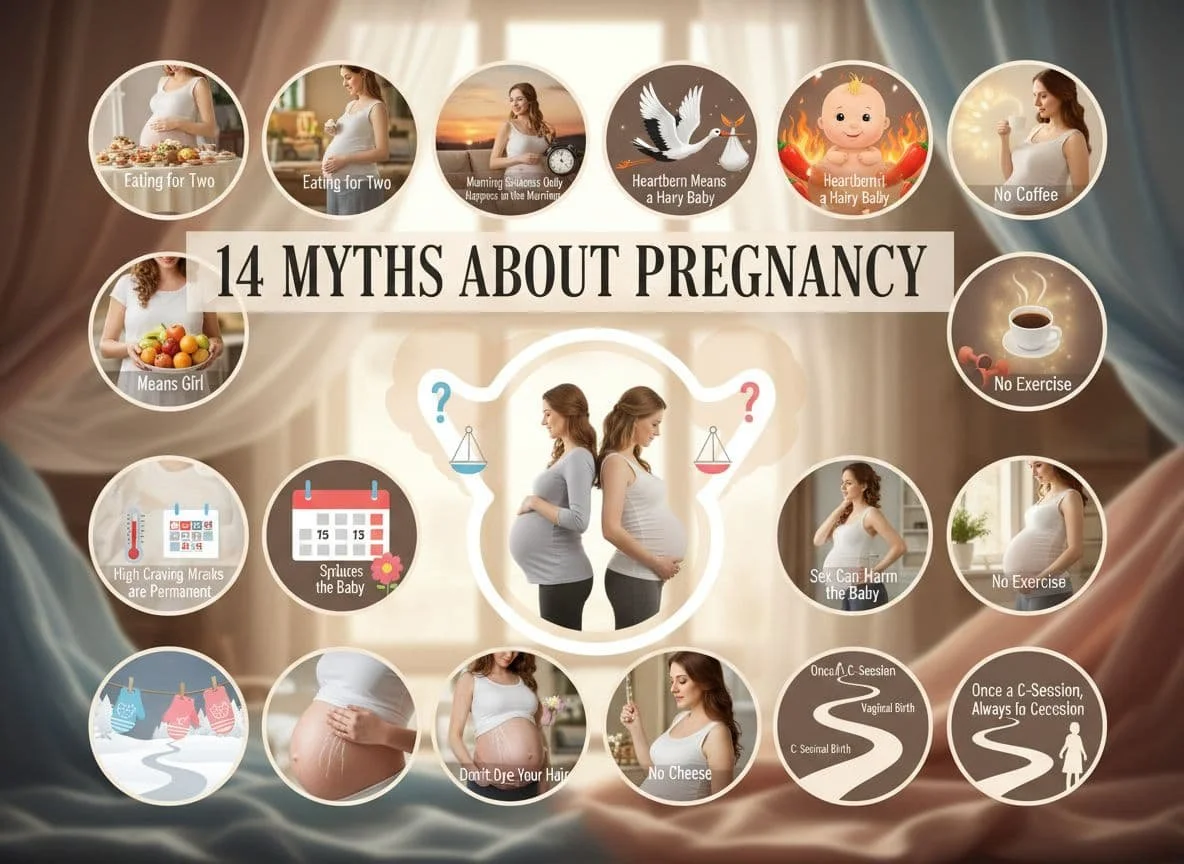
(Debunked With Clear, Calm Facts)
Something about pregnancy converts the most mundane decision into a profound question. Can you have coffee? Should you stop exercising? Is that heartburn “a sign” of something? Throw in advice from family, friends, social media, and strangers behind you at the grocery store, and it’s easy to feel like you’re doing something wrong.
This post debunks 14 pregnancy myths that often rear their heads in the US and instead offers equally practical but this-time-doctor-backed truths. We’re not trying to police your choices. It’s to help you breathe a little bit easier and focus on what does: your health, your baby’s health, and support that fits your real life.
Why pregnancy myths feel so convincing
Most pregnancy myths are not intended to be harmful. They’re usually old “rules” that once had a ring of truth to them, or anecdotes that spread because they were simple and memorable. A clever line like “eat for two” travels more quickly than a nuanced truth like “you definitely need some specific nutrients, plus a modest calorie bump down the road.”
Also, pregnancy symptoms are unpredictable. When there is something intense, like nausea or fatigue, the brain searches for an explanation that’s simple. That’s how myths stick. Facts often feel less dramatic, but they help in making better choices and easing anxiety.
For more examples of common old wives’ tales, Geisinger has a helpful roundup of pregnancy myths debunked.
14 myths about pregnancy (and what’s actually true)
Myth 1: “You’re eating for two, so you should eat double.”
Your baby needs nutrition, not twice as much food security. A lot of people really need only slightly increased calories in the second and third trimesters, closer to maybe 300 or a few hundred more calories a day. What matters most is the quality of food: protein, fiber, iron, calcium, folate, and healthy fats.
If you want a simple gut check, build meals on real food that is nameable. Snacks need to be for filling gaps in the rotation, not for feeling compelled to “keep up with” a fiction.
Myth 2: “You must avoid exercise while pregnant.”
For most pregnancies, the advice to stay active is a good one. The easiest movement to practice in pregnancy is gentle; it simultaneously helps with sleep, mood, and digestion and can build stamina for labor. Think walking, swimming, or prenatal strength work and mobility exercises, with your clinician’s guidance.
The actual rule is more straightforward: stay away from activities that you’re likely to fall in, that involve frequent and heavy contact with other players, or where you feel lightheaded, faint or have a general sense of pain. Your body is sending you live feedback, and it deserves to be listened to.
A quick overview is also covered in Novant Health’s guide to common pregnancy myths.
Myth 3: “Sex during pregnancy hurts the baby.”
Sex is safe in most uncomplicated pregnancies. Babies are being protected by the uterus and amniotic fluid. What might change is your comfort, energy, and interest—and that’s okay too.
Give your clinician a call if you are bleeding, leaking fluid, or having severe pain or if you have any restrictions (like placental problems or a risk of preterm labor). Otherwise, intimacy is all about comfort—not danger.
Sharecare addresses this concern in its list of biggest pregnancy myths.
Myth 4: “Morning sickness only happens in the morning.”
The name is a lie. Nausea can strike at any time of day, and for some people it lasts beyond the first trimester. There are various triggers: an empty stomach, a strong odor, weather (heat), stress, and certain foods.
You just can’t push through severe nausea (you are unable to keep liquids down, or you’re losing weight, or you feel weakened). There’s a treatment for this—and you deserve it.
Myth 5: “Heartburn means your baby will have lots of hair.”
It’s a cute story, but it isn’t an accurate indicator. Heartburn is common in part because the hormones of pregnancy cause the valve between the stomach and esophagus to relax, as does your ever-expanding uterus. A little bit of research has shown that baby hair is mostly unrelated to heartburn, but it is hardly a prediction by any means.
If heartburn is bad, inquire about what’s safe, and make small tweaks like eating smaller meals and remaining upright after consuming one.
Myth 6: “Belly shape or carrying high or low reveals the baby’s sex.”
The shape of a belly is not just about your current size, but it’s also related to how tall you are, what kind of muscle tone you have, whether this is your first pregnancy or your fifth, and if the baby has his head jammed in the right spot—as well as where that placenta sits. It doesn’t reveal chromosomes.
If you want to find out the sex, the best ways are timing on an ultrasound, NIPT blood tests, or diagnostic testing when medically indicated. Everything else is entertainment.
Parents has a straightforward explainer on common pregnancy myths.
Myth 7: “Cravings mean your body is missing that nutrient.”
Sometimes cravings dovetail with shifts in appetite, nausea patterns, culture, comfort, and habit. They are not consistently indicative of a particular deficiency. Cravings for ice are sometimes associated with low iron, but again, these are not diagnostic cravings.
If you’re concerned, I would suggest asking for labs rather than just guessing. It’s also fine if cravings are emotional. Pregnancy is an all-cells-on-deck, all-life event.
Myth 8: “If you don’t have symptoms, something must be wrong.”
Others feel like crap right away. Others feel surprisingly normal. Both can be healthy pregnancies. What your symptoms turn out to be will depend on hormones, genetics, how much you sleep, how stressed you are, and how your body’s immunological system responds.
A better signal is your prenatal care schedule, ultrasounds if indicated, and calling your clinician for the signals that could trouble you, like heavy bleeding, severe pain, or sudden swelling.
Myth 9: “You must avoid all seafood.”
You don’t need to ban seafood. Omega-3 fats, including DHA and EPA, in fish support the development of fetal brain and eyes. The key is selecting low-mercury options and avoiding raw or undercooked seafood because of the risk from infection.
Here’s a quick cheat sheet:
| Better low-mercury choices | Fish to avoid, often due to high mercury |
| Salmon | Swordfish |
| Sardines | King mackerel |
| Pollock | Shark |
| Shrimp | Tilefish (Gulf of Mexico) |
When in doubt, check current guidance with your clinician or a trusted public health source, because local advisories can vary.
Myth 10: “One small glass of wine is fine.”
This myth persists because it’s soothing, especially during the holidays. But major medical organizations in the United States recommend against drinking alcohol during pregnancy because there’s no known safe amount or time to drink it. Drinking alcohol can negatively impact fetal development, and the risk is not knowable individually.
If you drank before you were aware that you are expecting, welcome to the club. Raise it at prenatal care without shame and concentrate on what you are able to control now.
Myth 11: “Caffeine is totally banned.”
Most pregnant people can still consume caffeine in moderation. What “moderation” means will vary as a function of your health history, but the standard advice is that intake should be restricted (to no more than, say, 200 mg per day). Caffeine lurks in coffee, tea, soda, energy drinks, and chocolate; it all adds up quickly.
If you’re looking to cut back, combine half-caf, substitute a cup for tea, or front-load your caffeine in the morning to safeguard sleep.
Myth 12: “You can’t dye your hair while pregnant.”
Hair dye tends to be cast as a villain, but for most people, occasional coloring has been deemed low risk, especially after the first trimester and if used in well-ventilated areas. The more pressing concern is inhaling strong fumes or skin irritation.
When in doubt, ask for highlights (since the color doesn’t touch the scalp), wear gloves, and try to keep the room well-ventilated. If you have breaks in the scalp or a skin condition, touch base with your clinician.
Myth 13: “Cat owners have to rehome their cat.”
You do not need to give up your pet. The issue is toxoplasmosis, which can be transmitted through cat feces, in particular from outdoor cats that prey on animals. The quick fix is to try not to scoop litter if you don’t have to. They cannot be too cautious about how often their hands are washed.
Also keep in mind: gardening and undercooked meat are sources as well. This is an oversimplified fable that terrifies people for no good reason.
Myth 14: “Pregnancy brain means you’re getting worse at life.”
Memory loss and brain fog are typical, and it does not mean you aren’t doing well. Sleep disruption, stress, physical discomfort, and a heavy mental load can make anyone feel scattered. For some, it’s more noticeable at work; for others, at home; and some people don’t experience it at all.
Test some remedial supports: pedometers, lists, fewer tabs open (in your browser and perhaps in your mind), and bedtime at 8 or nine or whenever you can manage it. If you are feeling low or panicky, or you’re not functioning right, get help. That’s not “pregnancy brain”; that’s a symptom you need help with.
A quick reality check: when to call your clinician
Myths can make a lot of noise, but there are warning signs that have earned the microphone. If you experience heavy bleeding, severe abdominal pain, fluid leaking and/or fainting later in pregnancy, or a severe headache that won’t go away with vision changes, or decreased baby movement at any point in your pregnancy—contact your prenatal health care team immediately. If something doesn’t seem right, and you don’t know why, that’s reason enough to question it.
If you want more examples of myths and why they’re misleading, this hospital-based overview is also useful: 10 Pregnancy Myths Busted: A Guide for Moms-to-Be.
Conclusion
Pregnancy advice can be like a crowded room where people shout at you from every corner. The reality is more peaceful: Almost no “rules” actually exist, and most decisions come down to your health history and what your clinician recommends. When you listen to a new claim, stop and wonder, “Is this true, or is it just a familiar line?” Pick and choose solid advice; let the rest roll off your back. If you have heard a myth and it’s still creeping into your mind, write it down and discuss it at your next appointment.
Key Takeaways
- This article debunks 14 myths about pregnancy, providing doctor-backed truths to ease concerns.
- Many pregnancy myths are based on outdated beliefs or oversimplified anecdotes, making them feel convincing.
- Common myths include misconceptions about nutrition, exercise, and symptoms during pregnancy.
- Pregnancy requires listening to your body; consult your clinician for symptoms that cause concern.
- Prioritize accurate information to focus on your health and the baby’s well-being instead of outdated rules.
Estimated reading time: 9 minutes


В нашей клинике пациент может получить помощь на всех этапах лечения алкоголизма: от детоксикации и кодирования до завершающего восстановительного этапа лечения — курса медицинской реабилитации. Такой подход позволяет не ограничиваться временным облегчением после запоя, а сформировать план дальнейшей работы с человеком и его близкими. Медицинский центр неро-мед — это сеть специализированных амбулаторий, проводящих лечение зависимостей и оказывающих психотерапевтическую помощь при различных проблемах.
Ознакомиться с деталями – [url=https://n.narkologicheskaya-klinika-v-kemerovo18.ru/]частная наркологическая клиника Кемерово[/url]
I’ve been looking for a smooth app experience and this one delivers. The loading speed is impressive and the interface is very intuitive. Highly recommend 5777betloginapp for anyone who hates lagging.
Super easy registration and I was playing within minutes. I really appreciate the transparency regarding the odds. Give idhoki69 a try.
Really liking the variety of games here. Everything feels fresh and the customer support is top notch. Give rosohokilogin a try for sure.